
 Born at the moment Neil Armstrong landed on the moon, Nate Smith has lived a life defined by service. The son of an African American father raised in the segregated South and a mother born in wartime Taiwan, Nate grew up with a deep sense of excellence, discipline, and commitment to others. After entering the U.S. Air Force Academy at 17, he spent more than 28 years on active duty as a pilot, test pilot, and leader, followed by time in private industry—before answering a calling to medicine. Now a medical student at Tulane University, Nate sees his path not as a career, but as a journey of service.
Winn Awards: Can you tell us a little about your background?
Nate: My dad was born in the United States, in North Carolina, in the segregated South. He joined the military after high school. My mom was born in Taiwan during World War II, when the Japanese were bombing the island. Her parents didn’t even know if she would survive, and they never really kept her birth records.
Our parents had very humble beginnings, but they instilled in us a drive for excellence and service. I’m really thankful for both my parents and the sacrifices they made. At 17 years old, I entered the United States Air Force Academy and took an oath of service to our nation. I think my life has been focused on a life of service since.
After the Air Force Academy, I went to MIT for a master’s degree in aeronautical engineering. I later flew F-16s in both the Pacific and European theaters, became a test pilot, and served over 28 years on active duty. Some of the most significant experiences of my life came during combat operations, where I saw firsthand what it meant to be part of a disciplined, mission-driven team focused on stopping evil and protecting life.
Winn Awards: How did those experiences shape your perspective on service?
Nate: Being able to mentor and serve is what I really enjoyed in the military. One of the most significant moments for me was during a NATO air campaign in Kosovo. I remember leading my first combat operation, seeing the coordination, the precision, and knowing that people I had never met were willing to risk their lives to save mine if something went wrong.
At that moment, I knew we were part of the best trained, best equipped fighting force in the world to do good. That sense of service stayed with me.
Winn Awards: What led you toward medicine later in life?
Nate: After the military, I spent time in private industry, which was a blessing. But my wife, who is also in medical school, and I are really committed to service. She has spent years counseling women through our church, but in addition to ministering to the heart and soul—we also have a passion to address the body.
As a physician, you have the credentials and the knowledge to speak into both. It would be very easy to stop and retire, but the need is great, and we’re ready to serve.
Winn Awards: How did you become involved with the Winn Clinical Investigator Pathway Program?
Nate: At Tulane, a previous alumna, Anita Cook, had gone through the program and shared her experience. After thinking about the opportunity more, I realized this program was the only thing that really made sense. It’s structured well, and it’s a great program.
 Winn Awards: Can you describe your Winn CIPP research experience?
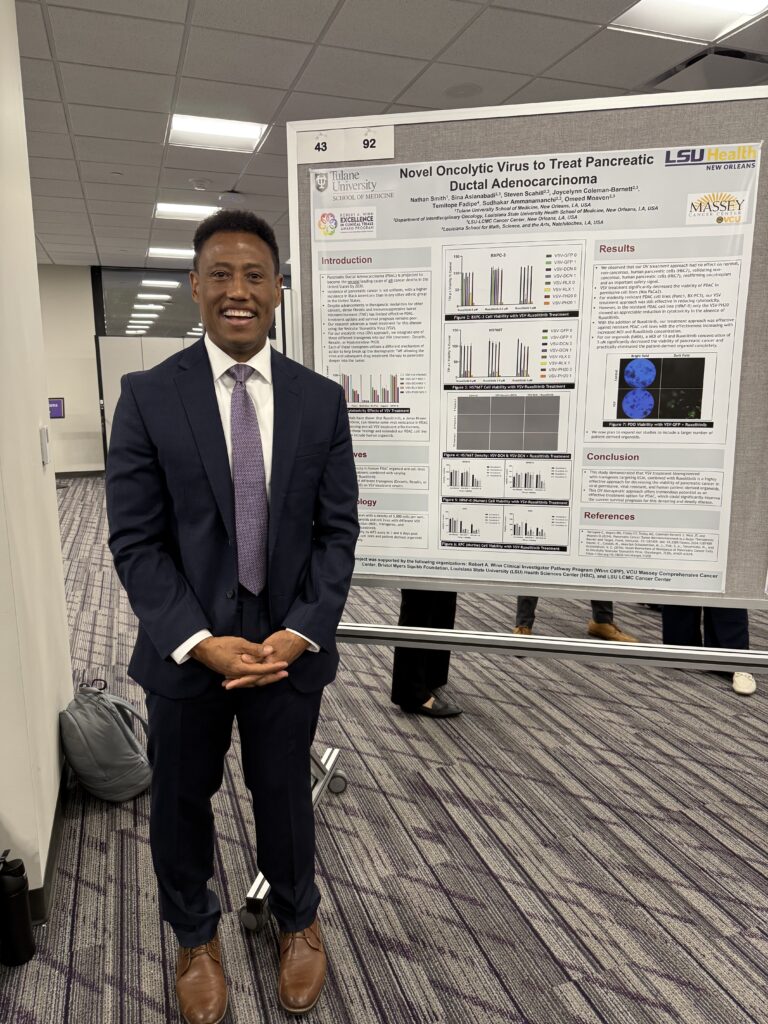
Nate: I worked on a project that really defined what I want to do as a physician. I’m drawn to surgery and cancer, particularly pancreatic ductal adenocarcinoma, which will be the second leading cause of cancer death in the next five years.
The research focused on a novel oncolytic virus—genetically engineered to kill cancer cells while sparing normal cells. Our approach significantly decreased the viability of pancreatic cancer cells and human organoids. It crushed it.
What made it even more meaningful is that before medical school, a close friend of mine was diagnosed with pancreatic cancer and passed away shortly after I started school. Being able to work on research that could move the needle, even a little, meant a lot to me.
Winn Awards: How did this experience compare to your previous research background?
Nate: I have a PhD in aeronautical engineering, so I’m familiar with research, but this was my first bench-level biomedical research experience. We worked with human organoids—three-dimensional models that more accurately represent real tumors. Seeing our approach work not just on known cell lines, but on patient-derived organoids, was incredible.
Winn Awards: What impact did Winn CIPP have on you overall?
Nate: Being able to see that research is actively addressing significant, challenging problems—and being given the opportunity, mentorship, and trust to contribute—was huge. Dr. Milei paired me with a surgeon doing cutting-edge research and plugged me directly into the team, even though I only had about a month.
The opportunities were phenomenal. It showed me that I can continue doing this, even as I move forward in medical school.
Winn Awards: How do you think about your future now?
Nate: I don’t really think in terms of a career anymore. I think in terms of service. If I’m in a position where I can help somebody, then I’ll do it.
My goal is competent, compassionate care, whether that’s through research, clinical work, leadership, or mentorship. I’m just grateful for opportunities like Winn CIPP and hopeful that sharing this experience might inspire others or help support the work being done.